How to watch Wimbledon 2026 | Order of play, winners & more info
 • 24 Jun 2026
Guides
• 24 Jun 2026
Guides
Centre court drama from the comfort of your home or on the go
The oldest and most prestigious event in all of tennis has returned, with another exciting edition of Wimbledon set to bring thrills to southwest London.
As the very best tennis players in the world descend upon the grass courts, check out how you can enjoy the action this year plus more important information for the gentlemen’s and ladies’ singles competitions.
How to watch Wimbledon 2026
As always, all two weeks of Wimbledon will be shown live on BBC across various platforms.
Live coverage will be available to watch daily on BBC One and BBC Two.
If you’re looking to stay tuned on the go or want your options away from watching on TV, your in luck as everything will be available on BBC iPlayer, which can be found as an app on an array of devices, including:
- Smart TV & Smart TV devices (Amazon Fire Stick etc.)
- Console (Xbox & PlayStation
- Computer/Laptop
- Mobile
- Tablet
Every evening will be the standard Today at Wimbledon show, highlighting everything that happened during that day of play and talking points from the tournament so far. This will be live on BBC Two and BBC iPlayer.
For those looking to tune in via radio, live coverage will be available throughout the tournament on BBC Radio 5 Live, BBC 5 Sports Extra and BBC Sounds.
And to keep up with things on the go, you can follow online on the BBC Sport website or on the BBC Sport app for your mobile or tablet.
When does Wimbledon 2026 start?
Wimbledon 2026 is technically underway, with the qualifiers currently taking place. However, the first official day of the tournament will come on Monday 29th June.
This is in keeping with one of Wimbledon’s many traditions, which is that it always starts on a Monday, with it either being the last Monday of June or the first Monday of July.
When is the Wimbledon 2026 final?
Wimbledon 2026 will run for its standard two weeks, ending with the men’s singles final on Sunday 12th July.
The women’s singles final will take place the day before on Saturday 11th July.
Wimbledon 2026 schedule
Wimbledon is the peak of the grass-court season, with other events such as the Queen’s Club Championship acting as highlight events that players use to get them ready for the different challenges of lawn play.
Running for exactly 14 days, Wimbledon sees each round last two days to allow players at least one day of rest.
The only times this may not be the case is for any delays in a game. For example, if a match got started later in the day and rain caused a stoppage, by which time the light disappeared when they went to resume, they would halt play with the game set to resume the following day. In this case, the player may find themself having to play on back-to-back-to-back days.
With all that said, here is the current schedule as it (hopefully) will be played for the gentlemen’s and ladies’ singles contests:
- Monday 29th & Tuesday 30th June - First round (both)
- Wednesday 1st & Thursday 2nd July - Second round (both)
- Friday 3rd & Saturday 4th July - Third round (both)
- Sunday 5th & Monday 6th July - Fourth round (both)
- Tuesday 7th & Wednesday 8th July - Quarter-final (both)
- Thursday 9th July - Ladies’ Semi-finals
- Friday 10th July - Gentlemen’s Semi-finals
- Saturday 11th July - Ladies’ final
- Sunday 12th July - Gentlemen’s final
Wimbledon 2026 key players
Gentlemen’s singles
Credit: An EPIC rivalry for the ages | Carlos Alcaraz v Jannik Sinner | Extended Highlights | Wimbledon 2025 (Wimbledon, YouTube)
2025 champion Jannik Sinner is the clear favourite to win a second Wimbledon title, not solely because his main adversary Carlos Alcaraz will not be competing (although that plays a big role), but also because the Italian has been in fine form in 2026.
That said, even that purple patch before Roland Garros didn’t make it a foregone conclusion as he fell in just the second round due to a severe physical setback that came on while he was mere points away from advancing.
While he has reassured fans that his physical condition is of no doubt now, there is more of a thought now that others stand more of a chance against the top two now, particularly Alexander Zverev, who went on to win in France.
Having finally achieved his goal of winning a Grand Slam, he may have the confidence now to bring more of a challenge to Sinner at SW19.
The US has two top 10-ranked players currently, with 23-year-old fifth-ranked Ben Shelton improving year after year while seventh-ranked Taylor Fritz went all the way to the semi-finals in 2025.
Though of course, we mustn't forget about one of the most successful competitors to ever grace the grass courts of Wimbledon, Novak Djokovic. Even at 39-years-old, he can still pose a threat to the youngsters.
Ladies’ singles
Credit: A Champion's display! | Amanda Anisimova vs Iga Swiatek | Extended Highlights | Wimbledon 2025 (Wimbledon, YouTube)
On the ladies’ side, current world number one Aryna Sabalenka has had a tough 2026, losing in the Australian Open final and experiencing a complete shock breakdown in the quarter-finals of the French Open.
Wimbledon is the only Grand Slam she hasn’t competed for the silverware so she will no doubt be making that her aim at least this year.
Iga Swiatek is the defending champion, having completed her career Grand Slam with her 6-0, 6-0 victory over Amanda Anismova. She should and is still regarded as one of the favourites, but as is her opponent in last year's final, the American only growing in strength since then and now sits at fifth in the world rankings.
19-year-old Mirra Andreeva is the next phenomenon on the ladies’ side. After her sensational breakthrough that saw her reach the quarter-finals last, she has grown in 2026 and claimed her first Grand Slam title in France. Maybe a second could be coming this summer in southwest London.
2022 champion Elena Rybakina hasn’t been back to the final since the win but this year claimed her second Grand Slam title at the Australian Open. A poor showing at Roland Garros could mean she will be aiming to bounce back at the tournament where she historically plays her best tennis.
As for other potential victors; two-time Grand Slam champ Coco Gauff can never be counted out, although grass is her least favourite surface; the same goes for Naomi Osaka, who has never made it further than the third round at SW19, but isn’t a four-time major winner for nothing.
But the most sensational entrant to this year’s competition is the return of the GOAT. Serena Williams is making a sensational comeback in singles competition, aiming to equal the great Margaret Court in total Grand Slam titles.
History of Wimbledon
As introduced at the start, Wimbledon is the oldest and most prestigious tennis competition in the world.
The modern game of tennis derives from the original racquet sport known as ‘real tennis’, or more regally known as “the sport of kings.”
Real tennis was played indoors; however, in 1876, eight years after the All England Lawn Tennis and Croquet Club was founded (1868), Major Walter Clopton Wingfield moved the sport from inside to outside, dubbing it ‘lawn tennis’, which is the name now given to any tennis competition played on a grass court, such as Wimbledon.
In 1877, the club changed its name to the All England Croquet and Lawn Tennis Club, and signalled the change by hosting the first Lawn Tennis Championship - this would go on to be recognised as the first Wimbledon Championship and first Grand Slam/major tournament.
The first eight tournaments were simply the one Gentlemen’s contest, but in 1884, the club added the Ladies’ singles competition as well as the Gentlemen’s doubles. The Ladies’ doubles and mixed doubles events were added in 1913.
As with the other three Grand Slams when they were introduced later on, Wimbledon was contested by top-ranked amateur players, with professionals prohibited from taking part. This changed with the introduction of the open area in 1968.
Traditions
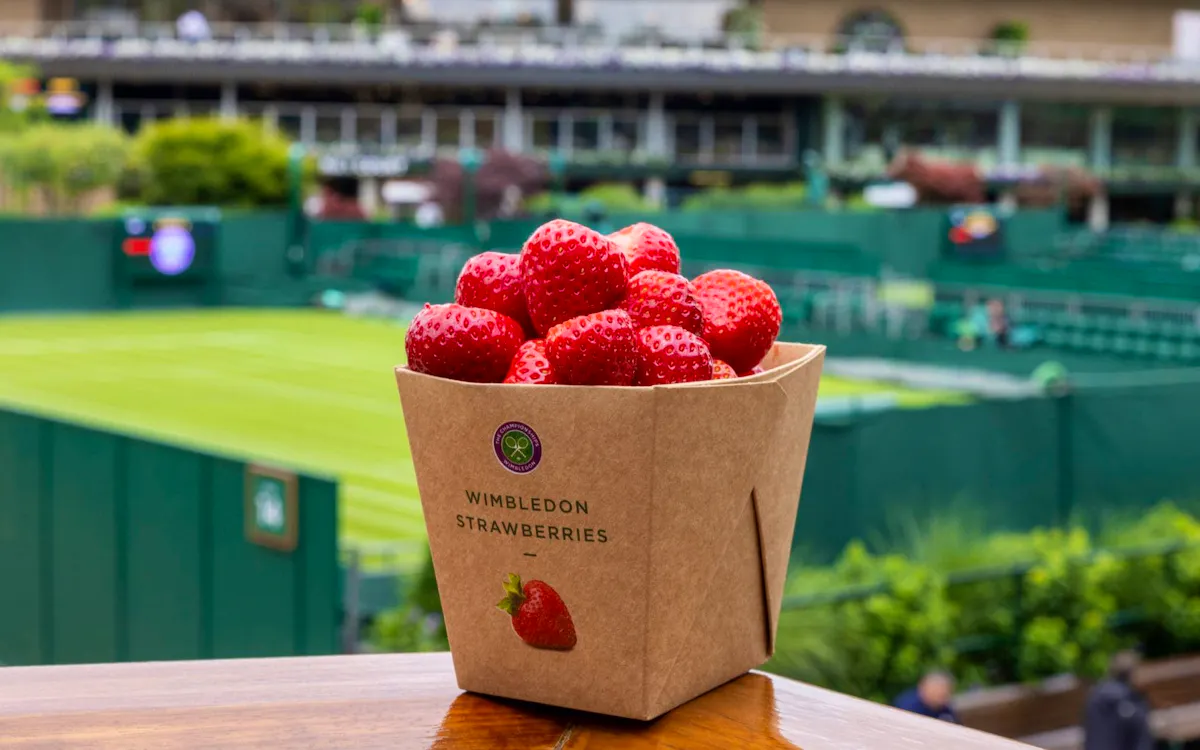
Being as honourable and prestigious as it is, Wimbledon has a number of traditions that remain in place today. Some have disappeared in keeping with the modern game, but others still remain.
For example, the colour scheme. Dark green and purple are the traditional Wimbledon colours, though all players competing in the tournament must wear all-white or as close to all-white clothing. This has been the way since the rule was first imposed in 1963.
The ball boys and girls, known as BBGs, are carefully selected and rigorously trained before every tournament. 250 BBGs are on hand to work across all the courts, and none are told which courts they will be working on prior to the start of the day to ensure the same standards across all courts. They are paid, too - around £17 a day, or £160-£250, depending on how many days they served.
As opposed to the other majors that simply use “Men’s” and “Women’s” competitions, the terms “Gentlemen’s” and “Ladies’” competitions is used solely at Wimbledon.
There is one “tradition” that will be ending this year, with the use of automated electronic line judges being in place instead of standard in-person line judges, a first for the tournament.
There are more traditions that we could name but then we’d be here forever. Instead, we’ll end off with the traditional tournament snack that spectators can indulge in and has become synonymous with the tournament, strawberries and cream.
This tradition is said to stem from a visit King Henry VIII made to his Lord Chancellor, Cardinal Thomas Wolsey, who at the time lived at Hampton Court, some six miles from Wimbledon.
Wolsey’s cook is rumoured to have served wild strawberries and cream as a dessert, and since back then the King and Queen of the nation held all the power and thus a lot of popularity, the dessert gained popularity with the general public.
In all honesty, we’re not quite sure how it then made its way to becoming popular during Wimbledon, but that’s just how we English folks roll!
Original format & years played
In the original format, the winner from the previous year’s competition would only have to play in the final, rather than the whole competition. His opponent would have to earn their place to challenge him.
As we mentioned earlier, Wimbledon is played out over two weeks, typically starting either on the last Monday of June or the first Monday of July and finishing on a Sunday.
That wasn’t always the case, though, as before 1982, the competition ended a day earlier, with the Ladies’ singles final ending on the Friday and the Gentlemen’s singles final on the Saturday.
There was also a tradition known as “Middle Sunday”, a rest day after the first week of play. This was used to allow for players to get a rest for the competition ahead, but also to let the groundsmen sort out the grass on the courts, as it would often be in need of repairs.
Exceptions to this came in 1991, 1997, 2004 and 2016, when rain had delayed play on the Saturday before and caused some matches to be played on the Sunday. This was known as “People’s Sunday” in 1991 as the gates were opened to spectators for cheaper tickets that came with unreserved seating.
From the nature of “Middle Sunday” came “Manic Monday”, coined due to the second Monday of the tournament being the busiest day of the competition. All last-16 matches for both Gentlemen’s and Ladies’ singles were played on this day, something which only happened at Wimbledon.
Unfortunately, this all came to an end in 2022, when they got rid of the need for “Middle Sunday” due in one part to players getting enough rest during the competition, and in another part due to modern-day courts not needing as much maintenance.
Wimbledon has been held in all but 11 years since the first tournament in 1877. There was no competition between 1915 to 1919 due to World War I, then again no competition from 1940 to 1945 due to World War II. Most recently it was cancelled in 2020 due to the COVID-19 pandemic.
Hometown heroes
Despite being a British tournament held on grass courts, which in theory should come as an advantage to British players, there has not been much success from home-soil players since the early 1900s.
Originally, when the competition was in its earliest days, it was only British players winning and competing, with a sprinkling of Australian and US competitors some years later.
The first non-British Gentlemen’s finalist was Australian Norman Brookes in 1905. Coincidentally, this was also the same year the first non-British player won Wimbledon, with the USA’s May Sutton winning the Ladies’ singles competition that year.
The first Gentlemen’s non-British champion was Brookes, who got his win in 1907. He essentially opened the floodgates with his win as three years later, the first of New Zealander Anthony Wilding’s four-peat championships came.
There then came a stretch of 25 years without a British Gentlemen’s champion, with Fred Perry finally breaking that in 1934 (yes that same Fred Perry who may better be known now as the fashion brand).
After Perry’s three consecutive titles came an even darker period for British Gentlemen’s champions. We wouldn’t see a hometown hero emerge victorious from Wimbledon until 2013 when Andy Murray famously overcame Novak Djokovic for his first of two Wimbledon titles (his second coming in 2016).
On the Ladies’ side, similar to the Gentlemen’s, the competition was largely contested between British players until Sutton won in 1905. While the floodgates weren’t opened per se then or soon after, more differing winners started to appear.
American players long saw the most success on the Ladies’ side at Wimbledon. It is two Americans who hold the records for most titles in both the open and amateur eras.
The last British female to win Wimbledon was Virginia Wade in 1977. This was also the last time a British female has even made the final of Wimbledon.
Wimbledon venue and courts
Credit: Take A Flight Through Centre Court | Wimbledon 2022 (Wimbledon, YouTube)
The All England Lawn Tennis and Croquet Club is the home of Wimbledon and has been from the very start. Based at Church Road, Wimbledon, London, the area and subsequent tournament is sometimes known as SW19, referring to the venue postcode.
The club consists of 18 Championship grass courts as well as 14 grass practice courts, with the most prominent of which being Centre Court and No.1 Court, two of the Show Courts.
Centre Court got its name from being the main principle court, with the remaining courts arranged around it.
The club moved location to Church Road in 1922 due to the rising popularity of the game and Wimbledon tournament, but the name Centre Court stuck for the main court used for the final.
Centre Court has received several facelifts over the years, with most recently a sliding roof being added in time for the 2009 championships.
It has 14,979 seats and is most notifiable for its royal box, where the British royals take their place if in attendance, and the iconic scoreboard, which closely resembles the original that was installed in the 1950s.
No.1 Court was built in 1997 and holds 11,500 people, thus being recognised as a second Show Court. It was given its own retractable roof in 2019.
The other Show Courts are No.2 Court, No.3 Court, 12 and 18, all of which have extra seats and typically are saved for elevated matches during Wimbledon.
Away from the courts themselves, the venue is known for its grandeur and things to do and see. There are multiple sculptures to marvel at, such as one of Fred Perry.
The Hill is the name given to a popular area for Grounds Pass ticket holders to sit and watch the action on large screens placed on the outside of No.1 Court.
During the 1990s, The Hill was known as Henman Hill due to the popularity of then-British number one Tim Henman, with floods of spectators who didn’t have tickets to watch him on Centre Court during semi-finals looking for a view.
Later, when Andy Murray rose to prominence and subsequently started winning, The Hill became known as Murray Mound, although many still associate it with the original Henman Hill.
Wimbledon last 5 winners
Gentlemen’s singles
- 2025 - Jannik Sinner
- 2024 - Carlos Alcaraz
- 2023 - Carlos Alcaraz
- 2022 - Novak Djokovic
- 2021 - Novak Djokovic
Ladies’ singles
- 2025 - Iga Swiatek
- 2024 - Barbora Krejcikova
- 2023 - Marketa Vondrousova
- 2022 - Elena Rybakina
- 2021 - Ashleigh Barty
Wimbledon records
Gentlemen’s singles
Most titles
Open Era – 8, Roger Federer (2003-2007, 2009, 2012, 2017)
Amateur Era – 7, William Renshaw (1881-1886, 1889)
Most consecutive titles
Open Era – 5, Bjorn Borg (1976-1980) & Roger Federer (2003-2007)
Amateur Era – 6, William Renshaw (1881-1886)
Youngest champion
17 years, 7 months – Boris Becker (1985)
Oldest champion
41 years, 6 months – Arthur Gore (1909)
Matches played
223 – Jean Borotra (1922-1939, 1948-1964)
Matches won
105 – Roger Federer (2001-2021)
Longest match
11 hours, 5 mins – John Isner vs Nicolas Mahut (2010)
Longest final
4 hours, 57 minutes – Novak Djokovic vs Roger Federer (2019)
Ladies’ singles
Most titles
Open Era – 9, Martina Navratilova (1978-1979, 1982-1987, 1990)
Amateur Era – 8, Helen Wills (1927-1930, 1932-1933, 1935, 1938)
Most consecutive titles
Open Era – 6, Martina Navratilova (1982-1987)
Amateur Era – 5, Suzanne Lenglen (1919-1923)
Youngest champion
15 years, 9 months – Lottie Dod, England (1887)
Oldest champion
37 years, 9 months – Charlotte Cooper, England (1908)
Matches played
326 – Martina Navratilova (1973-2006)
Matches won
120 – Martina Navratilova (1973-2004)
Longest match
3 hours, 45 minutes – Chanda Rubin vs Patricia Hy-Boulais (1995)
Longest final
2 hours, 45 minutes – Lindsay Davenport vs Venus Williams (2005)
Find a Deal
Enter your postcode now to see the best deals in your area.
Don't miss our latest deals
Sign up to receive unmissable offers and the latest news on TV, broadband, energy, phones and more.